Macaulay planning rules take key step as four councillors exit over donation conflict
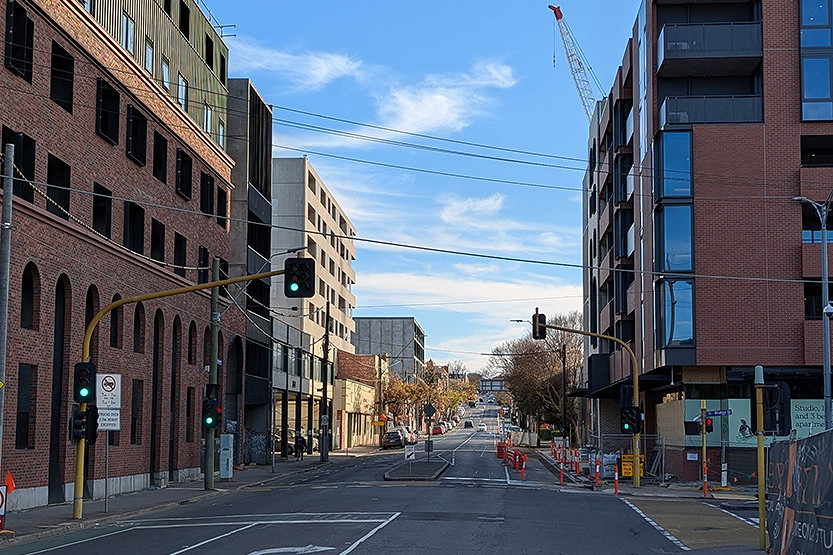

Long-awaited permanent planning controls for the Macaulay urban renewal precinct have taken a major step forward.
At the City of Melbourne's December 2 Future Melbourne Committee (FMC) meeting, seven councillors voted to send the draft Macaulay Structure Plan and associated planning scheme amendment to an independent panel – but only after four Team Reece councillors left the chamber due to a donation-related conflict of interest.
Deputy Lord Mayor Roshena Campbell was first to declare “a material conflict due to a campaign donation from a related entity to a submitter”. She was immediately followed by Cr Mark Scott, Cr Kevin Louey and Lord Mayor Nick Reece.
Deputy planning lead Cr Phil Le Liu took over as chair and moved the motion to request Planning Minister Sonya Kilkenny to appoint an independent panel to consider 63 submissions received during the exhibition of Amendment C417 between August and September 2024.
“For me, this is about Macaulay’s future,” he said, describing the package as “the balance between growth and liveability for both developers and the community”.
The amendment seeks to implement the Macaulay Structure Plan 2021 into the Melbourne Planning Scheme, setting new rules for building heights, setbacks, density, land-use mix, and streets and open space across the fast-growing inner-north precinct.
Cr Le Liu noted that the decision was “not final”, but a necessary step so submissions can be tested at a public panel hearing and refinements made before any final controls are approved.
Cr Davydd Griffiths, who seconded the motion, underlined the scale of the work and the stakes for the area.
“I really want to thank everyone who’s been involved in putting this document together – 847 pages – and that doesn’t happen without a huge amount of work,” he said, pointing to detailed submissions from both developers and residents with “real passion and real care for the suburbs that they live in”.
He said getting updated controls in place was now urgent, given the rapid pace of development already reshaping Macaulay.
The 63 submissions reveal familiar tensions in Melbourne’s urban renewal areas: how hard to push density, how much to mandate mixed uses and affordable housing, and how to secure open space and better streets without stifling development.
State housing agency Homes Victoria, which controls the public housing estate in North Melbourne, warned the draft controls could undermine the government’s Housing Statement goal of substantially increasing social and affordable housing.
In its submission, Homes Victoria argued that an eight-storey discretionary height, a mandatory 4:1 floor area ratio (FAR), strict overshadowing limits and a requirement for 20 per cent non-residential floorspace were “inappropriate” for a site that already hosts 13- to 21-storey towers and is earmarked for around 800 new homes.
“The amendment provides no justification for halving building heights compared to existing conditions,” the submission stated, adding that mandatory FAR and solar controls would “severely restrict” the government’s ability to deliver extra social housing on inner-city land. Homes Victoria is seeking to keep a mixed-use zone on the estate and to exempt it from the new design overlay.
Private landowners and developers also pushed back on elements of the package. Submissions from interests including R.Corporation, Greystar, Hines, M3 Group and others argued that mandatory density controls and a blanket expectation that 20 per cent of floorspace be non-residential would reduce dwelling yields, constrain architectural flexibility and risk the viability of projects in a precinct expected to absorb thousands of new residents.
Several called for FAR controls to be discretionary or paired with “uplift” incentives where projects deliver affordable housing, public links or additional community benefits.
By contrast, build-to-rent and affordable housing developer Assemble broadly backed the vision for a “mid-rise, mixed-use neighbourhood” with stronger open space and transport links, but said the amendment needed to better reflect approvals already granted and lessons from recent projects in the Stubbs St area.
While supporting clearer density and setback rules and stronger street and lane networks, Assemble urged flexibility in how floor area ratios, laneways and employment targets are applied so that projects delivering social and affordable housing are not locked out by rigid controls.
Community groups have previously welcomed the structure plan as a long-overdue framework for tying Macaulay’s rapid housing growth to new parks, wider footpaths, safer cycling links and drainage upgrades along Moonee Ponds Creek.
At the same time, they have raised concerns about rising land values and the challenge of securing key “drainage land” and VicTrack-owned parcels for public open space if planning rules lag behind development.
Cr Griffiths told the meeting that progressing the structure plan and Amendment C417 was critical to giving locals and investors certainty after years of interim controls and delays in state sign-off.
“We need to get clarity for locals who are currently living there or working there or running businesses there … and those that aspire to do so in the future,” he said.
With councillors voting to refer the amendment and submissions to an independent panel, the focus now shifts to 2026, when the panel will report back and the Minister for Planning will decide whether to approve, modify or abandon the new controls.
For Macaulay’s current and future residents, the outcome will shape not just building heights and skylines, but the quality of streets, parks and community life in one of Melbourne’s most closely watched renewal precincts.
Macaulay is also expected to play a key role in the City of Melbourne’s aim to double the number of homes in the municipality by 2051 in line with the state government’s housing statement. •
Related Articles
Lord Mayor and residents slam state over Macaulay planning controls
Lord Mayor Nick Reece has launched a stinging attack on the state government’s handling of Macaulay, accusing Planning Minister Sonya Kilkenny of undermining more than a decade of planning work.
Read More
Older public housing residents rally to save their homes
A large group of older residents from public housing towers slated for demolition descended on state parliament this month with a petition calling for the plan to be halted.
Read More
Safety fears over new Racecourse Rd tram stop crossing
The pedestrian crossings at either end of a new tram stop in Racecourse Rd are unsafe, according to local residents, including a woman who suffered serious injuries when she was hit by a car at one of them.
Read More
Meet Ted – Brown Dog’s very own Brown Dog
New-look Joe Taylor brings Thai flavours to Errol St
 Download the Latest Edition