“An appalling process”: Council warns Macaulay vision is being pulled apart
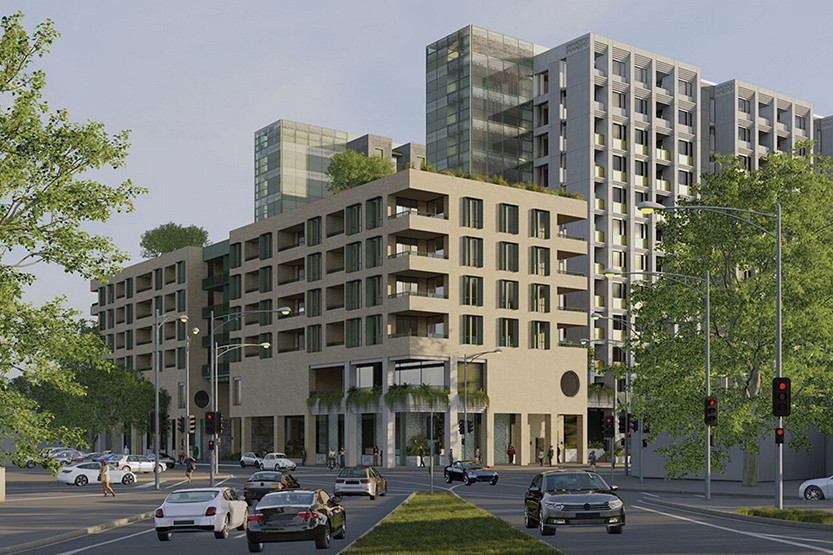

The future of Macaulay now rests with Planning Minister Sonya Kilkenny after the City of Melbourne issued a damning response to a state-appointed advisory committee accused of unpicking more than a decade of planning work for Kensington and North Melbourne.
At their July 7 Future Melbourne Committee meeting, councillors unanimously endorsed a council officer response urging the Minister not to adopt key recommendations of the Macaulay Structure Plan Advisory Committee, warning the recommendations would undermine the precinct’s long-held vision as a mid-rise, mixed-use urban renewal area supported by open space, jobs, affordable housing and community infrastructure.
The committee’s most controversial recommendation is to remove mandatory floor area ratio controls – the density caps that sit at the heart of the City of Melbourne’s planning scheme amendment C417.
Council officers warned that removing those caps would weaken the link between population growth and infrastructure delivery, creating the prospect of far greater development than the area’s roads, parks, drainage, flood mitigation works and community facilities have been planned to support.
The Macaulay Structure Plan, adopted in 2021 after years of consultation, was designed to guide growth across the 90-hectare renewal precinct spanning parts of Kensington and North Melbourne. It planned for around 10,000 residents and 9500 jobs, with a development contributions plan to help fund new open space, community facilities and streetscape upgrades.
But the state-appointed advisory committee has recommended making several mandatory controls discretionary, including floor area ratios (FARs), overshadowing controls, landscape setbacks and requirements relating to above-ground car parking.
Council management said full implementation of the committee’s recommendations would “undermine” the structure plan’s vision, including affordable housing outcomes, by removing mandatory FARs, omitting mandatory affordable housing contributions and weakening non-residential land-use requirements.
In a strongly-worded submission, Kensington Association chair Dr Kate Kennedy said it was “difficult to overstate how appalling the advisory committee process and final report are”.
The association said the recommended version of C417 was fundamentally different to what the public had seen and been consulted on and would “uncap density control entirely”.
It warned this could encourage development “more than twice” the level forecast in the structure plan, while leaving in place an infrastructure plan designed for a much smaller population.
“The advisory committee recommends that Macaulay can take more than triple the Structure Plan’s forecast population of 10,000 … but locks in an infrastructure plan designed to meet the needs of 10,000,” the association said.
“That is completely unacceptable.”
Dr Kennedy’s submission warned that abandoning FARs risked a “civil- and community-infrastructure crisis” that would be physically or financially impossible to fix, while fuelling land speculation and reducing housing affordability.
The association also raised concerns that small retail, hospitality and employment uses could be lost from main streets if non-residential use requirements were reduced to mere encouragement, and criticised weaker design requirements, including the potential for above-ground car parks to dominate parts of the public realm.
The Greens’ state MP for Melbourne, Ellen Sandell, also attacked the recommendations, accusing the state government of repeating “all the same mistakes of Docklands”.
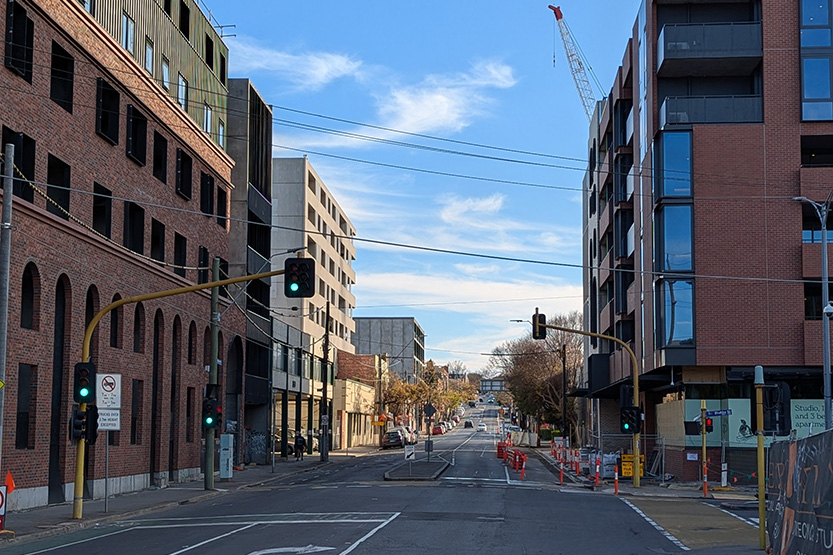
She said residents had been promised new parks, infrastructure and street-level activity to match growth, but could instead face “poorly-designed buildings” and less than half the promised infrastructure.
“Labor is increasing the density of this area by two to three times, but refusing to invest anything extra in parks, schools, affordable housing, public transport or traffic management to match the population growth,” Ms Sandell said.
The July 7 council debate was complicated by conflicts of interest.
Lord Mayor Nick Reece, Deputy Lord Mayor Roshena Campbell, Cr Kevin Louey and Cr Mark Scott all declared material conflicts due to campaign donations from a landowner potentially subject to a public acquisition overlay and left the chamber.
Cr Owen Guest was absent from the meeting.
That left the decision to six councillors: Cr Dr Olivia Ball, Cr Rafael Camillo, Cr Davydd Griffiths, Cr Philip Le Liu, Cr Gladys Liu and Cr Andrew Rowse. The motion, urging the Minister not to adopt the committee's main recommendations, was carried unanimously.
The conflicts again highlight a recurring tension in Macaulay decisions. Cr Reece and members of his team have had to recuse themselves from multiple votes relating to the structure plan and public acquisition overlays due to campaign donation conflicts linked to landowners in the precinct.
That creates an awkward political reality: the endorsed resolution requests that the Lord Mayor write to the Minister for Planning to press the council’s position, even though he was unable to participate in the vote that settled that position.
Cr Le Liu, who chaired the item, said Macaulay could and should contribute to housing supply, but growth needed to be planned carefully.
“We need planning controls that balance new development with liveability, affordable housing, open space, flood protection and community infrastructure,” he said.
He said the community’s vision had always been clear: a neighbourhood with housing, jobs, services, open space and infrastructure that supports future populations.
Cr Dr Ball was more blunt, also describing the outcome as “appalling”.
“This council has been stripped of our powers to complete this planning scheme amendment, and the casualty is not us, but our community,” she said.
She said the advisory committee’s recommendation to remove density-based controls “cannot proceed”, arguing it would be reckless to provide infrastructure based on one population forecast while allowing development that could produce far larger and unpredictable populations.
“This is planning done to communities, not with communities,” Cr Dr Ball said. “It’s an appalling process and there is nothing democratic about it.”
The council’s endorsed position asks the Minister to maintain mandatory FARs, include a discretionary affordable housing contribution, retain employment-use requirements, apply a public acquisition overlay to part of 18–76 Robertson St to expand Robertson Street Reserve, and continue pursuing overlays for state government land identified for Macaulay Terraces and Stubbs North Reserve.
It also supports further investigation of the active transport corridor within CityLink land.
After 13 years of planning, the council and community now face a nervous wait.
The advisory committee’s report is with the Minister, and the final decision on whether Macaulay becomes a carefully managed renewal precinct or a test case for uncapped density now sits with Spring Street.
North West City News understands the minister is expected to announce her decision by the end of July. •
Related Articles
Lord Mayor and residents slam state over Macaulay planning controls
Lord Mayor Nick Reece has launched a stinging attack on the state government’s handling of Macaulay, accusing Planning Minister Sonya Kilkenny of undermining more than a decade of planning work.
Read More
Older public housing residents rally to save their homes
A large group of older residents from public housing towers slated for demolition descended on state parliament this month with a petition calling for the plan to be halted.
Read More
Safety fears over new Racecourse Rd tram stop crossing
The pedestrian crossings at either end of a new tram stop in Racecourse Rd are unsafe, according to local residents, including a woman who suffered serious injuries when she was hit by a car at one of them.
Read More
Meet Ted – Brown Dog’s very own Brown Dog
New-look Joe Taylor brings Thai flavours to Errol St
 Download the Latest Edition